A place with several spellings
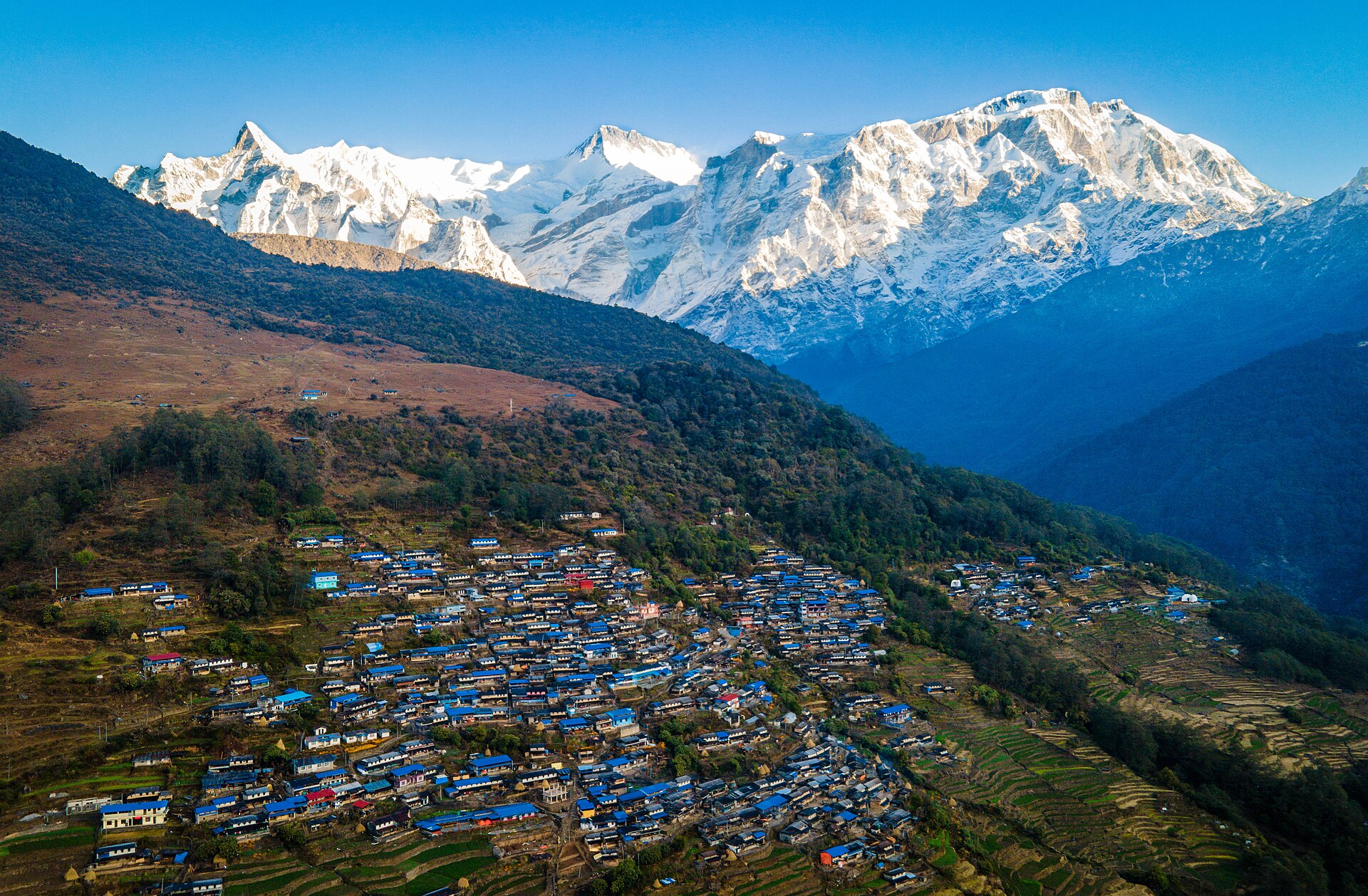
Sikles, Siklis and Sikles village appear in the sources used here. Variation in English spelling should not be mistaken for evidence of several unrelated settlements. The village is in Kaski, in the central Nepal Gurung homeland. Its significance in this collection is not simply its mountain scenery: it is a place where family, language, livelihood and specialist knowledge have been documented in detail. A photograph of today’s village shows a living settlement, not a reconstruction of ancestral times.
A centre of language documentation
ELA’s project with Narayan Gurung focuses on Sikles speech and includes work with speakers in the village as well as New York. Its account describes recorded narratives and conversations, a developing sketch grammar, and research on tone and voicing. The village’s Eco Museum also appears in ELA’s overview as the location of a map showing close to one hundred Gurung villages. The map is a community-oriented representation of settlement diversity, not a census of mutually unintelligible languages.
Knowledge holders and oral literature
Turin’s review of Strickland’s work names Padam Sing Gurung and Bir Bahadur Gurung as master practitioners whose knowledge supported the recording of pe in Siklis. Their presence makes the village a specific location in the history of Gurung oral-literature documentation. Treating them as knowledgeable collaborators helps move beyond descriptions that portray a village as a timeless cultural exhibit. The recorded literature represents work with particular experts at a particular historical moment.
Life-cycle rituals in a local study
Pol Bahadur Gurung’s 2022 article examines boys’ haircut and girls’ dress-giving initiation rituals in Sikles, using observation, interviews and case studies. Its abstract links the rites with recognition of maturity, family merit, gifts and renewed social relations. These are local customary accounts, not legal definitions of adulthood. The study provides a route into understanding how relatives and neighbours participate in growing up; it should not be used to prescribe what every Gurung child must do.
Sikles and Kohla are not interchangeable
Evans’s archaeological and ethnohistorical work investigates Kohla as an ancestral settlement, while Sikles is a present-day village connected to that broader landscape. Macfarlane and Indrabahadur Gurung’s older guide also places Siklis among villages with important herding traditions. These strands make Sikles useful for exploring both remembered ancestry and everyday livelihoods. They do not justify collapsing an archaeological site, a sacred journey and a contemporary community into one place or one period.
Sources & further reading
1Gurung: background, dialect research and documentation in New York
Language documentation organisation · Page-level claim citations not yet suppliedHaircut and Dress Giving Rituals of the Gurungs of Sikles Village
Peer-reviewed research · abstract consulted · Page-level claim citations not yet suppliedGrounding Knowledge/Walking Land: Archaeological Research and Ethno-Historical Identity in Central Nepal
Archaeological research · Page-level claim citations not yet suppliedReview: Materials for the Study of Gurung Pe, by Simon Strickland
Scholarly book review · Page-level claim citations not yet suppliedA Guide to the Gurungs (online draft; differs from published edition)
Ethnographic guide · Page-level claim citations not yet suppliedHeritage grows through conversation.
Know a different local account, or spotted something that needs correcting?
Share your knowledge